

Breaking the Impossible Trinity: Why Trinidad and Tobago Must Rethink Its Foreign Exchange Regime.
- The ValueCritic

- May 31, 2025
- 10 min read
Trinidad and Tobago is at a breaking point. A persistent foreign exchange (FX) shortage has left citizens unable to access US dollars to pay tuition, travel for medical treatment, or import vital goods. Businesses are struggling to finance inputs and repatriate profits. Yet, despite repeated promises of reform, the dysfunction persists. This is not merely a monetary problem. It is the inevitable consequence of a deeper economic contradiction, the Impossible Trinity.

In international economics, the Impossible Trinity (or Trilemma) asserts that a country cannot simultaneously maintain,
A fixed exchange rate: This means the value of the domestic currency is tied to another major currency (usually the US dollar). It offers predictability for trade and investment but requires active central bank intervention to maintain the peg, often through the use of foreign reserves.
An independent monetary policy: This allows a country to set its own interest rates and manage liquidity conditions based on domestic needs such as inflation control, employment, and economic growth. It assumes central bank autonomy from external monetary influences.
Free capital movement: This refers to the unrestricted flow of money in and out of the country for purposes such as trade, investment, education, and portfolio diversification. It supports global integration but limits a country’s control over its own monetary environment.
You can’t have all 3, a fixed exchange rate, full capital mobility, and an independent monetary policy because they pull in different directions.
If a country fixes its exchange rate and lets money move freely in and out, it can’t control its own interest rates. That’s because people will move money in or out depending on which country offers better returns. This puts pressure on the fixed rate and forces the central bank to spend reserves to defend it.
If a country wants to control its own interest rates and have open capital flows, then the exchange rate must be allowed to float, so it can move based on supply and demand, absorbing those flows.
If it tries to do all three at once, it runs into problems: reserves fall, inflation rises, or people rush to send their money out. This has happened again and again in real world financial crises, it's not just theory, it's a hard economic rule.
Trinidad and Tobago, however, has long attempted to maintain all three, this defies economic gravity. The result? A buildup of pressures that must be rationed through FX controls, delays, and black markets.
Dirty Float (approx TTD 6.78 to USD): T&T operates a managed float or "dirty float." The Central Bank intervenes heavily in the foreign exchange market to keep the rate stable, supplying USD at a fixed price to commercial banks based on a quota formula. This suppresses exchange rate flexibility and masks underlying currency pressures. Although labeled a float, it functions like a de facto peg.
Domestic policy control: (interest rates, inflation targeting): The Central Bank of Trinidad and Tobago (CBTT) continues to set its own monetary policy, including a repo rate that does not track the US Fed. CBTT has prioritized domestic inflation and economic indicators, resisting calls to follow global tightening cycles that could exacerbate local stagnation. Even as advanced economies tightened aggressively post COVID, the CBTT opted to keep its rate flat, citing modest local inflation and weak private credit expansion. This decoupling is central to CBTT's mandate of price and financial stability.
Partial capital openness (but porous and selectively restricted): While capital controls are not openly declared, restrictions exist on access to foreign exchange for tuition, imports, investment, and dividend repatriation. Some flows are blocked, others delayed, depending on central bank allocation windows and sectoral priorities. The data from 2010 to 2025 shows chronic gaps between demand and supply, with sales to the public consistently exceeding purchases from the public. Over time, this mismatch has required large and sustained CBTT intervention, underscoring a de facto rationing regime. Controls are enforced via Eximbank windows, transaction size thresholds, and sectoral preferences not through overt bans, but through administrative bottlenecks.

Source - CBTT
The chart above illustrates the chronic imbalance in T&T’s FX market. Sales of foreign exchange to the public (blue line) consistently exceed purchases from the public (orange line), forcing the CBTT (black bars) to inject large amounts of USD monthly. Rather than allow the exchange rate to adjust, the CBTT has preserved the peg through persistent intervention, validating the Impossible Trinity constraint. T&T is simultaneously trying to fix its exchange rate, retain monetary independence, and manage capital flows through administrative rationing rather than market pricing.
Maintaining a dirty float requires the CBTT to sell US dollars in defense of the exchange rate. But energy revenues, which once filled reserve coffers, have stagnated. Foreign reserves have dwindled while demand for USD remains high. To avoid depleting reserves, authorities have imposed invisible capital controls:
Banks are allocated limited USD.
Personal travel allowances are capped.
Importers wait weeks for FX approvals.
Citizens resort to parallel markets ( black market rate is TTD 7.30+).
As demand exceeds supply, a 2 tier market has emerged. The official rate is de jure; the parallel rate is de facto. Inflation has begun leaking into prices as importers bake the parallel rate into costs.

For over 25 yrs, T&T has operated an "honour system" for distributing scarce FX. Commercial banks are given quotas from CBTT based on a formula that includes branch size and customer base. But this system lacks transparency, and has bred accusations of unfairness, hoarding, and favoritism.
Press investigations and parliamentary debates have spotlighted:
Delays in tuition payments and healthcare travel.
Firms shifting to the black market.
Government ministers questioning the allocation mechanics.
The IMF has called for the removal of FX restrictions and a move to a more flexible, market based regime. This is confirmed by IMF's REER/NEER analysis, which shows that despite a 3.6% depreciation in T&T’s real exchange rate, the nominal rate (US$/TT$) has remained virtually unchanged since 2015. This gap, between real competitiveness pressures and a fixed nominal anchor, reflects sustained FX market intervention and further evidences that Trinidad operates a de facto peg, not a floating regime.
According to the IMF’s 2024 Article 4 review, the REER remains moderately overvalued by 1.9%, suggesting further external adjustment is needed. Yet the peg, supported by administrative rationing, delays this adjustment, trapping the economy in a cycle of distortion and imbalance.
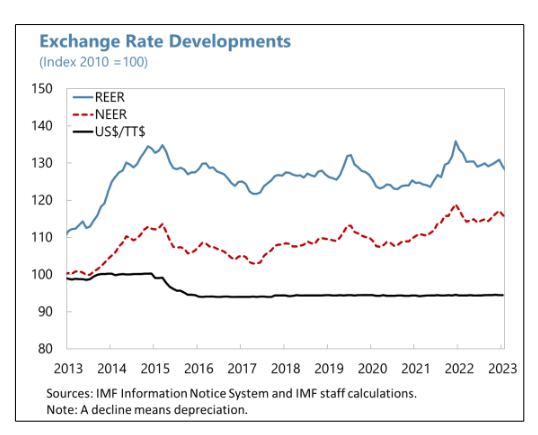
T&T’s system exchange rate was once underpinned by booming oil and gas exports. LNG shipments brought in billions in USD, providing a natural defense for the peg. That model no longer holds:
LNG volumes and prices have declined.
Petrochemical exports are volatile.
Non-energy exports are minimal.
Yet the currency has not adjusted. This has created a misalignment between the nominal exchange rate and Trinidad’s true terms of trade. The peg is no longer supported by fundamentals.
So What Are The Paths to Reform?
There are ways forward. Countries like Jamaica, Morocco, and Ghana have transitioned to managed float systems. This allows their currencies to reflect external conditions, absorb shocks, and attract capital. A managed float doesn’t mean chaos, it means control with flexibility.
A successful transition for Trinidad and Tobago would involve:
Launching a transparent FX auction system
A transparent FX auction system lets banks and businesses bid for US dollars instead of receiving them through closed door decisions at a fixed rate. The CBTT announces how much USD is available (for example, US$20mil), and then authorized participants submit bids saying how much they want and the rate they’re willing to pay in TTDs per USD. The highest bids are accepted first, and the auction continues until the full amount is used up. The last accepted bid sets the “clearing rate”, which becomes the new market exchange rate for that auction.
This system helps solve T&T’s FX problems by making the process open, rules based, and driven by demand not political connections or quota formulas. Everyone sees the results, including how much FX was sold and at what rate, which builds public trust and reduces black market pressure.
To make sure it’s fair and not abused:
a. Limits can be placed on how much any one company can buy at a time.
b. FX use must be declared (e.g., tuition, importing goods, paying suppliers), with documents if needed.
c. Penalties or audits can stop people from hoarding or sending money out of the
country without a valid reason.
d. Separate windows can be created for small businesses, students, or medical needs to ensure access for essential users.
Over time, this system helps reveal the true demand for foreign currency, reduces FX shortages, and prepares the country for a more flexible and modern exchange rate regime. The key to this system's success if enforcement, to ensure that FX are being used for the purposes people are applying for.
Letting the exchange rate gradually adjust.
Right now, T&T’s exchange rate is managed by the Central Bank, which intervenes by selling US dollars to keep the TTD stable. But this peg doesn’t reflect actual market pressure, demand for USD is higher than supply, which is why a black market exists at TTD 7.30+.
A gradual adjustment means the CBTT would stop enforcing a hard fixed rate and instead allow the TT dollar to move within a controlled range. The exchange rate would begin to float slightly, guided by outcomes in daily FX auctions or actual market trades, rather than being held artificially steady. This approach avoids the shock of a sudden devaluation by letting the TTD weaken step by step, in a way that reflects real economic pressures like trade balances, investor demand, and external conditions. It provides flexibility while maintaining stability, helping the country shift toward a more credible and resilient exchange rate system. The CBTT could,
Start with a Narrow Band - Let the exchange rate float between, say, TTD 6.78–6.90. This introduces flexibility without volatility.
Widen the Band Gradually- Every few months, widen the band slightly (e.g, 6.75–7.00), depending on FX flows and inflation.
Use FX Auctions to Set the Rate- Let daily or weekly FX auctions determine the rate, creating real time market discovery.
Communicate Clearly- Explain to the public that this is a controlled adjustment, not a collapse and that it’s aimed at improving access to USD and reducing the black market.
Support with Inflation Targeting - Use interest rate policy and fiscal tools to keep inflation under control during the transition .
Establishing an inflation targeting monetary framework.
While the CBTT does set its own policy interest rate, the repo rate and monitors inflation, this does not mean it operates under a formal inflation targeting framework. In a full inflation targeting regime, the central bank publicly commits to a specific inflation target (e.g., 3% +/-1%) and makes maintaining price stability its primary policy objective. It adjusts interest rates based on detailed forecasts and economic models that predict where inflation is heading, and it communicates these forecasts and its strategy transparently to the public through regular monetary policy reports.
Importantly, in such a framework, the exchange rate is not defended or fixed; it is allowed to move based on market forces, while the central bank focuses solely on keeping inflation expectations anchored. In contrast, the CBTT still uses monetary policy partly to support its soft exchange rate peg, and it has not published a clear inflation target or adopted consistent, forward looking guidance as done in true inflation targeting systems. Therefore, while it uses some of the tools, CBTT has not yet adopted inflation targeting in full and doing so would be a necessary step in transitioning to a more modern, flexible, and credible monetary policy regime.
Liberalizing capital flows in phases.
Liberalizing capital flows in phases means gradually removing the restrictions that limit how money moves in and out of T&T but doing so carefully to avoid economic shocks. At present, T&T does not officially impose capital controls, but in practice, access to FX for things like tuition, dividend repatriation, imports, and offshore investments is rationed and delayed through administrative channels, such as approvals from commercial banks and the Central Bank. This creates a system of de facto capital controls, where FX is selectively allocated and not freely available. A phased liberalization strategy would relax these restrictions step by step, allowing for more open capital movement once safeguards like stable reserves, FX price discovery, and policy credibility are in place. Some of the ideas used by other countries that once faced similar restrictions were done in phases for example, Phase 1: Prioritize Essential FX Access
- Fully liberalize FX for trade, tuition, medical payments, and travel.
- Streamline and automate approvals for documented transactions.
Phase 2: Enable Dividend Repatriation with Limits
- Allow foreign companies to repatriate a capped percentage of profits.
- Require declaration of audited earnings and proof of tax compliance.
Phase 3: Allow Personal Offshore Investments (Small Scale)
- Permit individuals to send up to US$10,000 to 15,000/yr for savings, real estate, or portfolio investments.
- Require national ID registration and reporting to the Central Bank.
Phase 4: Liberalize Business Investment Abroad
- Permit local firms to invest abroad under sector caps or exposure limits.
- Monitor through a central foreign investment registry.
Phase 5: Fully Open the Capital Account (When Ready)
- Remove remaining restrictions, allowing free flow of capital.
- Only after FX markets are liquid, inflation is anchored, and reserves are strong.
Strengthening reserves through IMF precautionary programs.
Strengthening T&T’s foreign reserves through an IMF precautionary program means securing access to additional FX liquidity before a crisis hits. Unlike emergency bailouts, these arrangements act like an insurance policy, they aren’t drawn on immediately but stand ready if needed. This builds investor confidence, supports the credibility of exchange rate reform, and provides a policy anchor during transition. Given the country’s declining energy revenues, persistent FX shortages, and soft exchange rate peg, a precautionary IMF arrangement would serve as a backstop to defend reserves and reassure markets. It also sends a strong signal to credit rating agencies, foreign investors, and local stakeholders that the country is committed to macroeconomic discipline and reform, without necessarily undergoing harsh austerity. Features and benefits of using this system includes,
a. Access to reserve support without immediate disbursement (standby arrangement or precautionary credit line).
b. Boosts investor confidence during FX and capital market reforms.
c. No stigma used by credible reforming countries like Colombia, Morocco, and Mexico.
d. Light conditionality compared to full structural adjustment programs.
e. Provides technical assistance and policy guidance from the IMF.
f. Signals reform seriousness and improves Trinidad’s credibility with multilaterals and credit rating agencies.
g. Supports gradual FX liberalization while avoiding a BoP crisis.
Trinidad and Tobago’s FX dysfunction is not a passing liquidity issue. It is a structural contradiction born from trying to do the impossible. The longer the country postpones reform, the higher the cost, in lost competitiveness, business closures, social stress, and reputational damage. The Trinity must be respected. It cannot be negotiated. T&T must choose. And the time to choose is now.


Comments